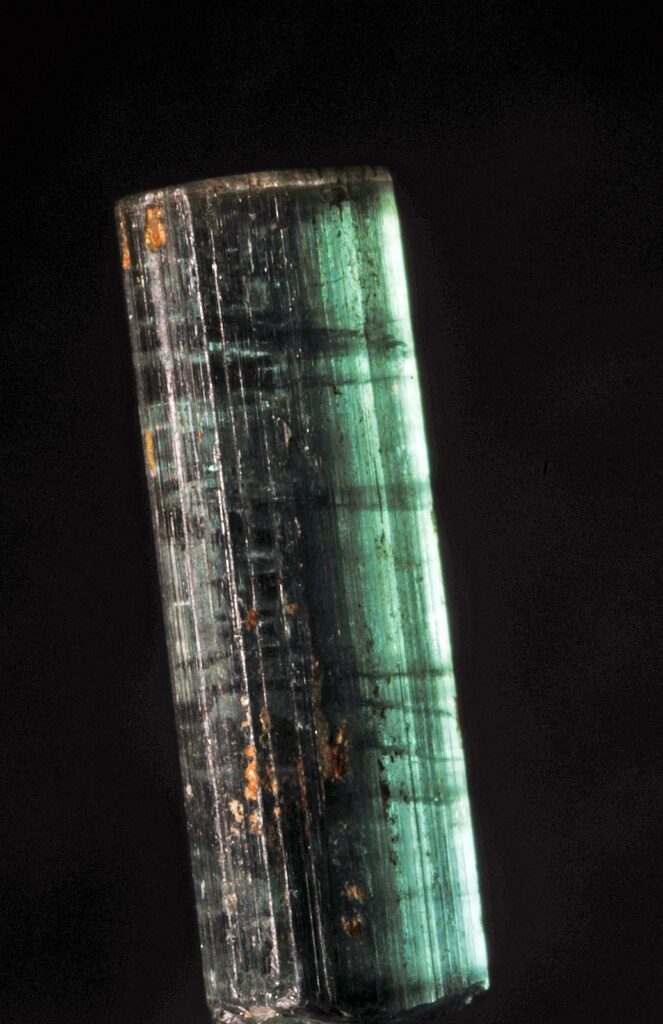
Paraíba tourmaline does not glow in the dark. That is the first thing to get straight, because the word most often attached to it, glowing, suggests something the stone does not do. It does not store light and give it back in darkness. What it does, under ordinary light, is look lit from inside: a blue or blue-green so saturated, and so clear, that the eye reads it as a light source rather than a coloured object. The colour comes from copper, an element almost never found in tourmaline in this quantity, and the stone is named for the Brazilian state where that copper-bearing tourmaline was first found.
A colour from copper
Tourmaline is a large family, found in almost every colour. Most tourmalines are coloured by iron, manganese, or other familiar trace elements. Paraíba tourmaline is coloured mainly by copper, with manganese also present. Copper is rare in tourmaline, and that rarity is the whole story. It produces a range of blue, bluish green to greenish blue, green, and yellowish green, at a saturation that other tourmalines do not reach. The trade words for it, neon and electric, are attempts to name a colour that stays vivid even in a small stone, and even in flat light, where most coloured stones go dull.
The laboratories that certify these stones have had to define the name carefully, because it began as a place and became a description. Under the shared definition used by the major laboratories, Paraíba tourmaline is a copper-bearing tourmaline of the specified colours, at medium-light to high saturation and tone, coloured mainly by copper and manganese, whatever its geographical origin. The name honours the Brazilian state where the stone was first mined, but it is a variety name, not a statement of origin. A stone with only traces of copper, or outside the defined colours, does not qualify, even if it comes from Paraíba itself. Origin is disclosed separately on a report.
That definition matters for a buyer because it draws a line that the market often blurs. Not every blue-green tourmaline is a Paraíba tourmaline, and not every stone sold under the name meets the laboratory definition. The test is not the seller’s word, and not the vividness of a photograph. It is the copper content and the saturation, as stated on a laboratory report.
Found in Brazil, then found again
The Brazilian story begins with the prospector Heitor Dimas Barbosa, who noticed small patches of unusual colour in pegmatite samples shown to him in the early 1980s. The vivid, electric-blue tourmalines were not found in quantity until August 1987, at the Batalha Mine near São José da Batalha in Paraíba state, in north-eastern Brazil, and the material reached the international market in 1989. The first crystals caused a sensation because nothing like that colour had been seen in tourmaline before. Production from the original Brazilian deposits was short-lived, and within about five years it had largely run out. Brazilian Paraíba tourmaline remains the reference against which later material is judged, and it remains scarce, with most crystals small and heavily fractured.
At the beginning of the twenty-first century, copper-bearing tourmalines of similar colour were found elsewhere: first in Nigeria, then in Mozambique. Mozambique has since become the principal commercial source of Paraíba-type material. The colours overlap, but they do not start from the same place. Much of the Mozambican material comes out of the ground pink to violet, and only a small share is blue-green as mined; heating removes the pink-violet part of the colour and leaves the copper’s blue-green. That does not disqualify a stone under the laboratory definition, which is about colour and copper, but it is information a buyer should have, because treatment and origin affect value and because a stone’s colour, once treated, should be stable under normal wear rather than assumed to be untouched.
The geography, then, is a history of a definition outgrowing its birthplace. The stone was discovered in one state in Brazil. The chemistry that defines it was then found in Africa. The name stayed with the chemistry, not with the mine.
Why the glow is not magic
It helps to say plainly what the eye is doing. A Paraíba tourmaline looks lit from inside because its colour is both saturated and relatively light in tone. A dark, saturated stone absorbs much of the light that enters it and returns little; a pale stone returns light but carries little colour. Paraíba tourmaline, at its best, sits between those two failures: enough colour to saturate the light that passes through it, and enough lightness for that light to come back to the eye. The result is a stone that seems to carry its own brightness, even though it is only returning the light in the room.
Tourmaline is also pleochroic: it can show different colours, or different strengths of the same colour, when viewed from different directions. A cutter has to orient the stone so that its best colour faces up through the table; cut with its weaker direction facing up, a Paraíba tourmaline will look paler than the rough promised. That is one more reason to judge the stone in the hand, turned in the light, rather than from a single photograph.
Durability sets a limit on wear. Tourmaline ranks 7 to 7.5 on the Mohs scale, hard enough for jewellery, but its toughness is only fair: it can chip or crack on a hard knock, and sudden temperature change or heat can damage it or change its colour. Ultrasonic and steam cleaners are best avoided; warm, soapy water is safer. A setting that leaves its edges exposed on a ring worn every day asks more of it than its toughness allows.
What to ask
Three questions cover most of what a buyer needs. Does a laboratory report call the stone Paraíba tourmaline, and on what basis, copper and saturation, rather than colour alone? Where does the stone come from, and has its colour been treated? And is the stone set and cut in a way that protects a material of fair toughness, rather than leaving it to take the knocks of daily wear?
The glow, in the end, is not a mystery and not a trick. It is copper, in an unusual quantity, in a tourmaline, at a saturation that lets light come back coloured. That is enough. A stone does not need to shine in the dark to be worth looking at twice.
— Tom