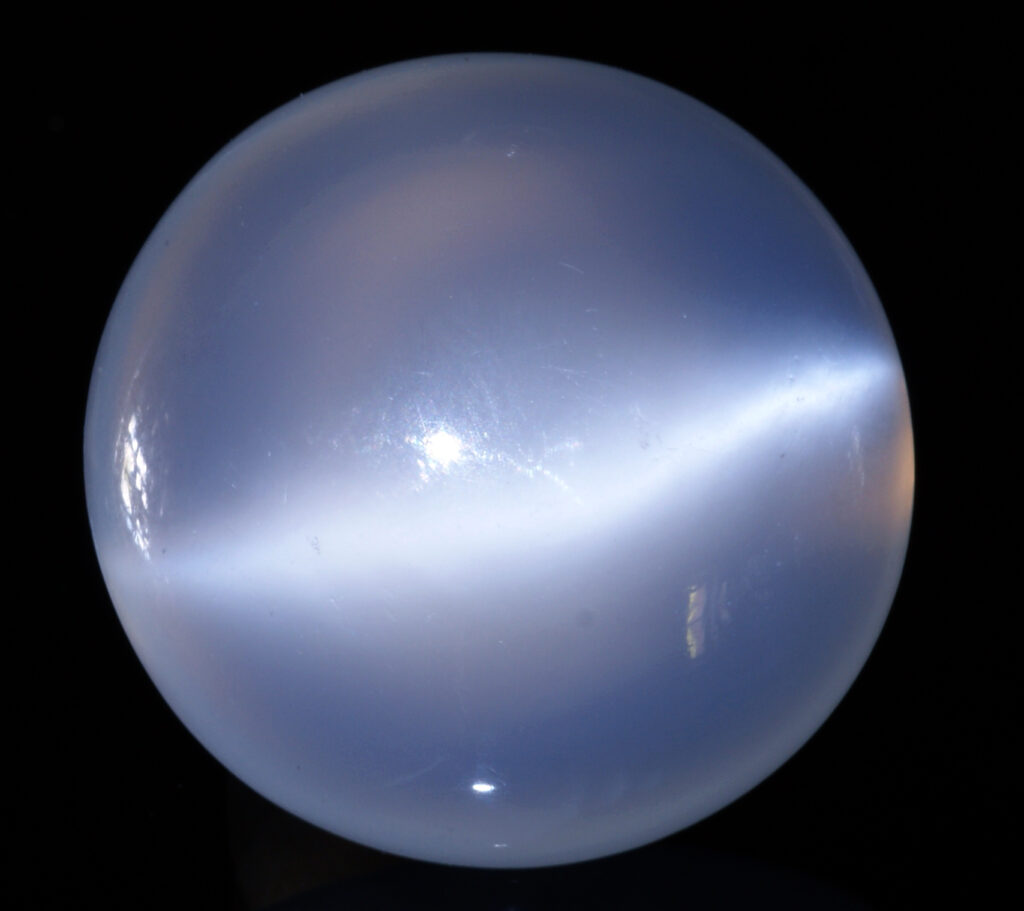
Some stones are valued for a colour that stays still. Moonstone is valued for a light that moves. Tilt a moonstone and a soft sheen rolls across the dome, gathers, and drifts on, like light seen through thin cloud. The sheen is not a polish effect and not a coating. It is built into the stone’s internal structure, and everything about moonstone — how it is judged, how it is cut, how it should be worn — follows from that structure.
Two feldspars in one stone
Moonstone is a variety of orthoclase, a potassium feldspar. Feldspar is the most common mineral group in the Earth’s crust, and moonstone’s particular character comes from the fact that it is not one feldspar but two. It is composed of orthoclase and albite, which begin intermingled in a single crystal as the mineral forms. As the newly formed mineral cools, the two feldspars separate into stacked, alternating layers, too thin to see with the naked eye.
When light falls between those layers, it scatters in many directions. That scattering is adularescence: a billowy, floating light that seems to sit just below the surface and to roll across the stone as the viewing angle changes. The effect is most often a soft blue, sometimes white or pale yellow. Because the light is scattered rather than reflected from a single plane, the sheen is visible over a wide range of angles. It moves, but it does not switch off the way a sharper flash does.
The structure also explains the stone’s appearance when the light is not moving. Fine moonstone is translucent to nearly transparent, pale, and quiet. The sheen is the stone; without it, the same material is an unremarkable feldspar.
A name that misleads, twice over
The word adularescence comes from adularia, a variety of potassium feldspar associated with Mount Adular in Switzerland. The term is, strictly, misleading: adularia itself does not show the effect it named. The name stuck anyway, and it is now the standard word for the sheen wherever it appears.
The naming is looser still at the level of the stone. Not every feldspar that shows adularescence is orthoclase moonstone in the strict mineralogical sense. Sanidine, another feldspar, can also produce adularescent gems that are sold, legitimately, as moonstones. For moonstone, the beauty of the sheen matters more to the name than the exact mineral identity. What defines the stone in practice is the quality of that floating light: the finest material appears colourless, nearly transparent, with a blue adularescence centred on the stone and visible from many angles.
One name in the trade, however, describes a different stone and a different effect, and it is worth a buyer’s attention. The pale, multicoloured material sold as rainbow moonstone is not moonstone at all; gemmological testing identifies it as a feldspar of another branch, with a sharper, more directional flash. That stone has its own article in this Journal, on labradorite. Here it is enough to say that the two sheens can be told apart at a glance once you know what each one does: moonstone’s light floats and lingers, and it does not need a precise angle to appear.
Where it comes from, and how it is cut
The most important sources of moonstone are Sri Lanka and India. Sri Lankan material is the classic reference for the type: pale, transparent stones with a blue sheen. Other sources exist, but when a dealer describes a fine blue moonstone, it is the Sri Lankan standard that is being invoked.
Moonstone is almost always cut as a cabochon, domed rather than faceted. The reason is optical, not decorative. A smooth dome lets the scattered light roll across the surface in one continuous movement; faceting would break that movement into competing reflections. The dome must also be oriented correctly against the internal layers, so that the sheen sits centred on the stone and shows face-up. A stone cut off its layers can carry a good structure and still look flat from the front, its sheen pushed off to one side. Judging a moonstone therefore starts with movement: turn it slowly under a single light and watch whether the sheen stays centred and alive, or slides away and dies at the angles where the stone will actually be seen.
How fragile the light is
The structure that makes the sheen also sets the stone’s limits. Moonstone ranks 6 to 6.5 on the Mohs scale, which is moderate hardness, but its toughness is poor. It has two directions of cleavage, planes of atomic weakness running through the crystal, and a hard blow can break a moonstone along them. High heat, or a sudden change of temperature, can also cause it to break. It is stable to light, so the sheen itself will not fade on a windowsill; the risk to a moonstone is mechanical and thermal, not visual.
Those limits decide where the stone belongs in jewellery. Makers usually set moonstone into pendants, earrings, and pins rather than rings, because rings are the pieces that receive knocks against door handles, stone counters, and tools. A moonstone ring is not impossible, but it asks for a protected setting and an owner who knows what the stone can and cannot take.
Cleaning follows from the same fragility. Warm, soapy water is the only recommended cleaning for moonstone; ultrasonic and steam cleaners are never recommended. The sheen is an internal structure, so it cannot wash off or wear away like a surface treatment. What can be lost is the stone itself, to a scratch, a chip, or a break along a cleavage plane.
The question to carry into a shop is therefore a practical one. Look for the sheen first: centred, floating, present from the angles at which the stone will be worn. Then ask how the stone is set, and whether that setting respects what moonstone is — a layered feldspar of moderate hardness and poor toughness, carrying a light that took two minerals and a slow cooling to build.
— Tom