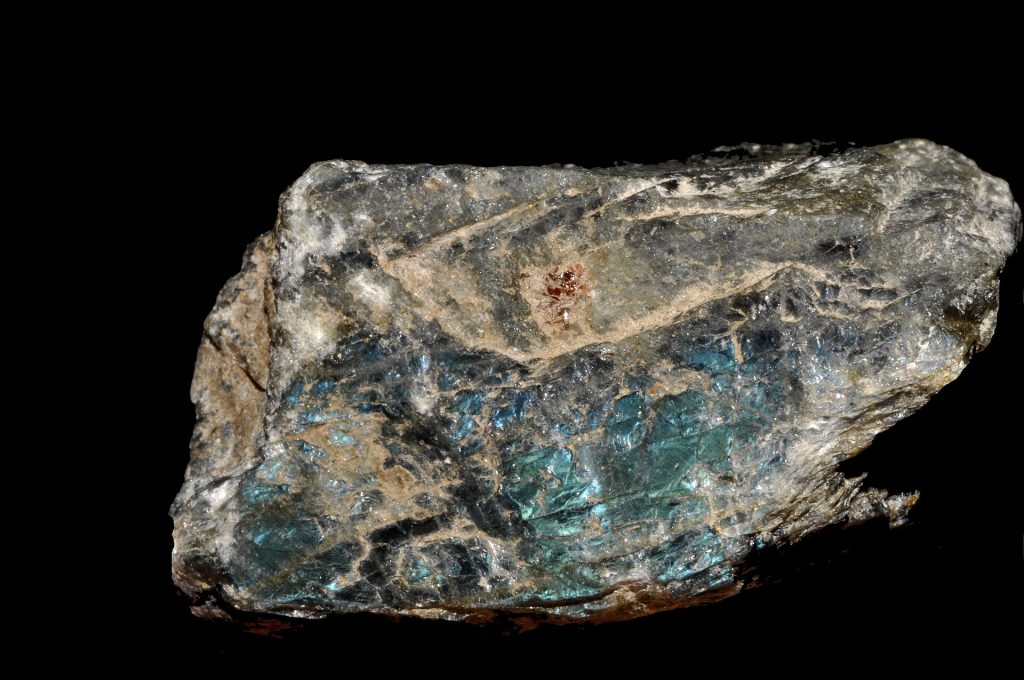
On the bench, an unpolished piece of labradorite looks like a poor bargain: grey, dark, ordinary. Then the stone is turned under the light, the angle comes right, and a sheet of blue spreads across the face — broad, flat, and unmistakable. Turn it a little further and the colour is gone, as completely as if it had never been there. That appearance and disappearance is the stone’s whole character. Labradorite is not valued for its body colour, which is a modest grey to near-black. It is valued for a flash that exists only at certain angles, and understanding the stone means understanding why the flash behaves that way.
A plagioclase feldspar
Labradorite is a member of the plagioclase series, the calcium-sodium branch of the feldspar family. Its composition sits between the two end members of that series, albite and anorthite, with the calcium-rich anorthite making up roughly 50 to 70 percent of the mix. It is a common mineral in dark igneous rocks, and most of it shows nothing remarkable at all. The gem material is the fraction in which a particular internal structure developed as the rock cooled.
That structure is a set of extremely thin, alternating layers — lamellae — of slightly different feldspar compositions, stacked inside the crystal. They formed during cooling, when a feldspar that had been uniform at high temperature separated into layers as the temperature fell. The layers are far thinner than the width of a hair, and their thickness is of the same order as the wavelength of light itself. That is the whole secret of the stone.
Labradorescence: interference, not pigment
When light enters labradorite, it meets those stacked layers and reflects from them at slightly different depths. The reflected waves overlap and interfere with one another. Some wavelengths reinforce each other and come back strongly; others cancel out. This is thin-film interference, the same family of effect that colours a soap bubble, and it produces labradorescence: broad flashes of colour that appear, shift, and vanish as the stone, the light, or the eye moves.
Because the colour is produced by interference, it is set by the geometry of the layers. The exact colours depend on the thickness and spacing of the lamellae in a given stone, which is why one labradorite flashes blue and its neighbour from the same rock flashes green or gold. Blue is the most common colour, followed by green; gold, orange, and violet occur, all of them displayed against the stone’s typically dark grey or black body. A stone whose layers happen to produce several colours in different patches can show two or three at once, in separate sheets that light up in turn as the stone moves. None of this colour is a pigment in the material. A labradorite ground to powder would be white dust.
This also explains the angle dependence that defines the stone at the counter. Interference works only when light meets the layers within a certain range of angles. Outside that range, there is no reinforcement and no colour — the stone returns to grey. A buyer who picks up a labradorite and holds it still under flat shop lighting may see nothing, and conclude the stone is dull. The same stone, turned slowly under a single light, will show exactly what it carries.
Labrador, Finland, Madagascar
The stone takes its name from Labrador, in Canada, where it was first recognised in 1770, on Paul Island off the Labrador coast. Material has since been found in many places around the world, and much of the cabochon rough on the market today comes from Madagascar.
One origin carries its own name. Spectrolite is the trade name for labradorite from Finland, quarried near Ylämaa in the south-east of the country, where the deposit was found in 1940 during the building of fortifications along the eastern border. Finnish material tends to show a fuller range of labradorescent colour — the whole spectrum, including red, which is rare elsewhere — set against a darker body than most labradorite. Spectrolite is still labradorite. The name marks the intensity and range of the flash and the origin that produces it, not a different mineral.
Labradorite also reaches the market under one borrowed name worth knowing. A pale, translucent labradorite from Madagascar, showing a multicoloured flash, is sold as rainbow moonstone. Gemmological testing confirms it as labradorite, and its flash is labradorescence, not the floating sheen of true moonstone. The distinction matters at the point of sale, because the two stones are priced differently and the name on the ticket should be the name of the mineral.
Cutting and wearing a stone that switches off
Labradorite is cut almost always as a cabochon, and the cut is an exercise in orientation. The lamellae lie in fixed planes inside the rough, and the flash appears only when the finished face is aligned so that the wearer’s line of sight meets those planes at the working angle. A cabochon cut a few degrees off can look dead from the front and flash only when tipped — a stone that performs in the hand and disappoints in the setting. The cutter’s judgement, made on unpolished rough, decides most of what the finished stone will do.
The material’s limits are those of its family. Labradorite ranks 6 to 6.5 on the Mohs scale, and it has perfect cleavage in two directions, the planes along which a crystal splits most readily. A sharp impact can break it along those planes, and its moderate hardness means it scratches more easily than quartz or the harder gems. It is therefore better suited to pendants, earrings, and brooches than to a ring worn daily against hard surfaces; a ring stone is possible, but it wants a protective setting and honest expectations. Warm, soapy water is the safe cleaning; ultrasonic and steam cleaners are better avoided, as with the other layered feldspars.
The practical test for labradorite is the one the stone itself imposes. Take it to a single light source, away from flat overhead lighting, and turn it slowly through a full range of angles. Note where the flash sits, how much of the face it covers at the angle the piece will actually be worn, and how quickly it dies. A good stone shows its colour at wearing angle, not only in the hand of the person selling it.
— Tom