Pearls sit in jewellery shops beside stones, are graded beside stones, and are sold by the same sellers as stones. They are not stones. A pearl is not mined, not cut from a crystal, and not faceted. It is grown inside a living mollusc, layer by layer, out of a material that no mine produces. That single difference explains almost everything that is unusual about pearls: how they are graded, how they are damaged, and how they should be kept. A pearl treated like a stone will not last like one.
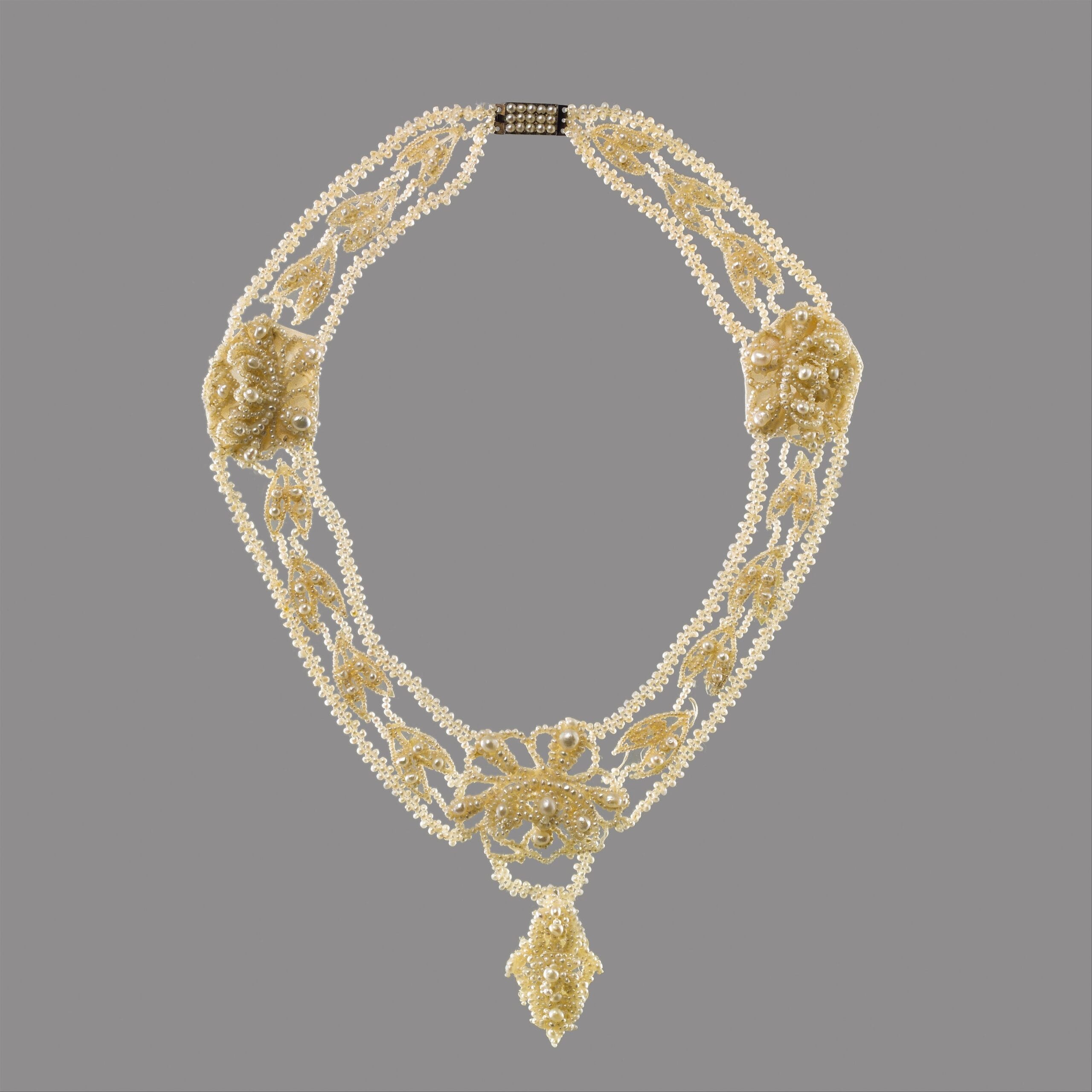
Grown, not mined
A pearl forms when a mollusc, an oyster or a mussel, deposits layers of nacre around an irritant or an introduced nucleus inside its body. Nacre, also called mother-of-pearl, is made of microscopic platelets of calcium carbonate, in the form of aragonite, held together by an organic substance called conchiolin. Layer upon layer, the platelets build a smooth surface whose lustre, the sharp, bright reflection of light from that surface, is the pearl’s defining quality. No cutting is involved. A pearl’s shape, surface, and lustre are the mollusc’s work, finished only by cleaning and, sometimes, by drilling.
That growth has two consequences. First, a pearl has no crystal structure to facet or to cleave: its beauty is a surface, built up in thin layers, and its strength is the strength of those layers. Second, a pearl is organic. It contains water and organic matter as well as mineral, and it can dry out, be attacked by acids, and be damaged by heat and chemicals that a crystal would ignore.
The distinction between natural and cultured pearls sits inside that growth, not outside it. A natural pearl forms without human intervention, when an irritant enters the mollusc by chance. Natural pearls are exceptionally rare. A cultured pearl is formed when a technician introduces a nucleus into a living mollusc, which then coats it with nacre in the same way. A cultured pearl is a real pearl, with the same essential nacre structure as a natural one. It is not an imitation. Imitation pearls, made of glass or plastic and coated to look like nacre, have no nacre at all, and no mollusc behind them. The word cultured describes how the growth was started, not whether the pearl is genuine.
Graded differently, for a different reason
Because pearls are not crystals, the usual language of gem grading does not fit them. Diamonds are graded on cut, colour, clarity, and carat weight, the four Cs. Pearls are described by a different set of factors: size, shape, colour, lustre, surface quality, nacre quality, and matching, in the system used by the Gemological Institute of America. Each factor follows from how a pearl grows.
Lustre comes first because it is the direct result of the nacre: thick, well-formed layers reflect light sharply, while thin or chalky nacre reflects it dully. Surface quality records the blemishes, pits, grooves, and bumps left by growth, since a pearl cannot be polished free of its own surface the way a faceted stone can be polished free of a flaw. Nacre quality records the thickness and structure of the layers themselves. In a nucleated cultured pearl, nacre thickness is a durability question as much as a beauty question: if the nacre is so thin that the nucleus shows through, or that the surface is chalky, the pearl will not wear well, whatever its shape.
Matching matters for pearls in a way it does not for most stones, because pearls are usually worn in strands and sets. A strand is judged as a group: pearls of similar size, shape, colour, lustre, and surface, sitting together without one member standing out. A single fine pearl and a matched strand are different achievements, and the grading reflects that. None of this is a version of the four Cs. It is a separate system for a separate kind of object.
Soft, and attacked by ordinary things
A pearl’s hardness is usually given as about 2.5 to 4 on the Mohs scale, depending on the source and the pearl. By any version of that range, it is soft. Dust in the air contains quartz, at hardness 7, and a pearl stored loose in a box with other jewellery will be scratched by the harder pieces around it. That is a storage rule, not a warning about wear: pearls should be kept apart from other jewellery, in a soft pouch or a lined compartment, not jumbled together.
Chemicals are the more insidious danger, because they are part of ordinary dressing. Nacre reacts to acids, and perfume, hairspray, cosmetics, and perspiration all carry chemicals that can dull or damage it. The old rule, perfume first and pearls last, is chemistry, not etiquette: the pearl should go on after anything sprayed or creamed has dried, and it should come off before anything else is applied. The same rule covers cleaning. Pearls should be wiped with a soft, dry cloth after every wear, to remove the oils and residues of the day, and cleaned only occasionally with a cloth dampened in lukewarm, mildly soapy water, then dried flat. Soaking is the error to avoid, because it weakens the silk thread of a strand and the adhesive in earrings and rings, and ultrasonic and steam cleaners are unsafe for pearls.
A strand adds a maintenance question that a single stone does not. Silk stretches with wear, and a strand worn often should be checked and restrung every one to two years, before the thread wears through. That rhythm, wipe after wear, gentle clean when dull, restring on schedule, is the whole of pearl care. It is habit, not effort, and it follows directly from what a pearl is made of.
The exception, stated plainly
The gemmologist’s exception is not a piece of trivia. It is a practical warning against treating all jewellery alike. A pearl is the only major gem that is the product of a living animal, built in layers of mineral and organic matter, graded by lustre and nacre rather than by cut and clarity, and damaged by the ordinary chemicals of a dressing table. Everything else in the cabinet is, in some sense, a stone. A pearl is an animal’s answer to an irritant, worn as an ornament, and it asks to be kept like what it is: soft, layered, and alive in its history, even after it has left the shell.
— Tom