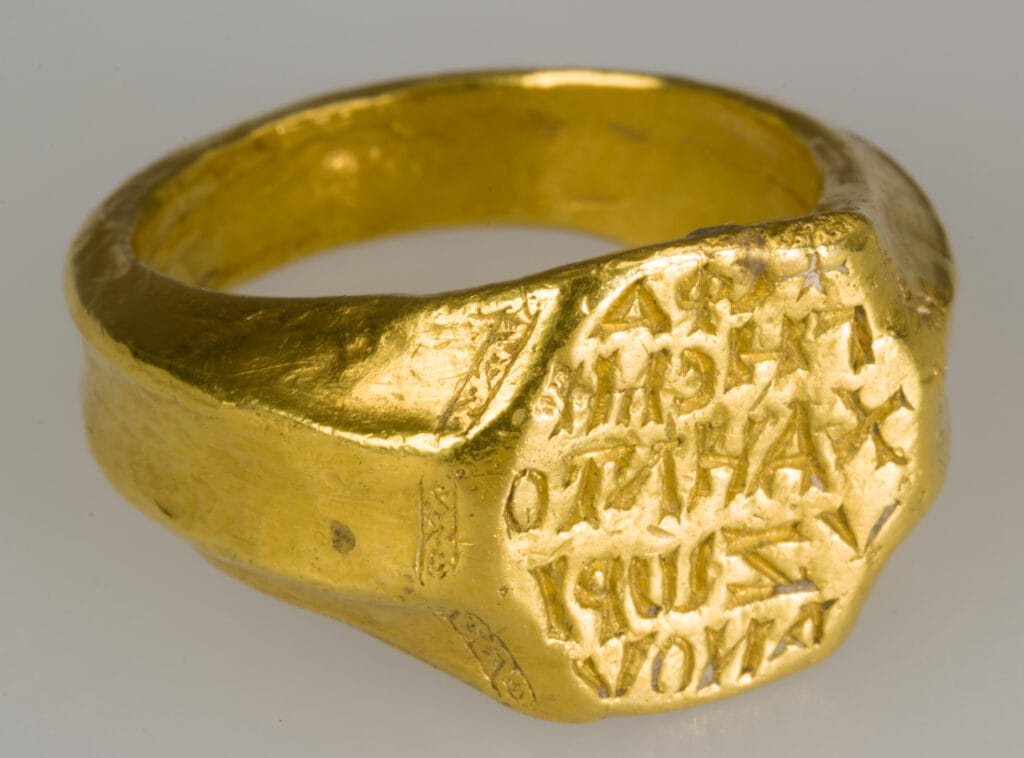
Before a signature was a handwritten name, it was a mark pressed into clay or wax. The ring that made that mark is the signet ring, and for most of its history it was not primarily an ornament. It was a tool for identifying the person who used it, for proving that a document, a jar, or a door had come from that person and had not been opened since. The ring survives today as jewellery, but its shape, its flat face, and its reversed engraving are all explained by the job it once did.
A seal before a ring
The signet ring did not begin as a ring. It began as a seal. In Mesopotamia, in the late fourth millennium BCE, small cylinders of stone, carved around their curved sides, were rolled across wet clay to leave a continuous strip of imagery. A cylinder seal, worn on a cord around the neck or pinned to clothing, could seal a storage jar, cover the knot of a bale of goods, or mark a clay tablet and the clay envelope that held it. The impression said who had handled the object, and because the clay would break if the object were opened, it said whether the object had been tampered with. The seal was, in effect, a signature and a lock in one small object.
The step from seal to ring was a step of keeping: a seal is only trustworthy if it stays in its owner’s hands, and the surest way to keep it close was to wear it on the finger. A seal threaded onto a wire and fixed to the finger became the signet ring. The Egyptians gave that form its recognisable shape: rings shaped like a sacred scarab beetle, with the owner’s name or a pictograph on the flat base, introduced around the middle of the Twelfth Dynasty, about 1800 BCE.
The engraving on a true signet is cut in reverse, in intaglio, sunk into the metal or stone rather than raised from it. That reversal is the key to the whole object. Pressed into soft clay or hot wax, a reversed design leaves a raised impression that reads correctly. A signet engraved the right way round would leave a mirror image, unreadable as a signature. The test of a signet, even today, is that its face looks backwards in the hand and correct in the wax.
The seal as a legal signature
For most of history, the seal did the work that a handwritten signature does now. In a society where few people could write, a wax seal carried legal authority: a document sealed with a person’s signet was that person’s document, and breaking the seal suggested tampering. The impression identified the sender because the design was unique to its owner, a monogram, a coat of arms, a family device, or a personal image, cut for one person and not repeated.
The Middle Ages made that authority formal. Noble families, landowners, bishops, and monarchs used engraved rings bearing coats of arms to validate official documents. By the fourteenth century, important legal documents were expected to carry a seal, and under Edward II of England it was established that official government documents had to bear the seal of the king’s signet ring. The rule was not decorative. A document without the king’s seal was not the king’s document.
That authority is also why signet rings were controlled so tightly. Monarchs did not allow copies of their own rings to circulate, because a copy could be used to forge their seal. Rings were often destroyed when their wearer died, so that the seal could not outlive the authority it represented. An authentic antique signet is rare in part for that reason: the system that gave it power also required its destruction when its power ended. A seal that survived its owner was a security risk, not a keepsake.
The seal’s reach went beyond documents. A signet could seal a letter, a package, a doorway, or a tomb, and in each case the logic was the same: the impression closed the object, and the closure could not be undone without leaving evidence. A letter opened and resealed would show a second, mismatched impression, or a broken one. The seal did not prevent a determined forger from copying a design, but it raised the cost of forgery from a pen stroke to a piece of engraving, and it made tampering visible.
When the signature changed hands
The signet’s legal power faded when handwritten signatures became common. Signatures were widely used in contracts only from the seventeenth century onward, and as literacy spread, the written name took over the work the seal had done. By the nineteenth century, the signet ring’s use as a legal mark had largely waned, though it remained popular as a fashionable item and a symbol of status and family. The ring kept its flat face and its engraving, but the engraving no longer needed to be reversed, because it no longer needed to print. Many modern signet rings are engraved the right way round, to be read on the finger rather than in wax. That change in direction is a small, visible record of a change in function.
What remains is the part of the signet that was never only legal: identity. A signet ring still carries a device chosen by its wearer, still sits on the hand where it can be seen, and still, when traditionally engraved, can be pressed into wax for a letter or an invitation. That use is now ceremonial, not legal, but the mechanics are unchanged: the ring still has to be cut in reverse to print correctly.
There is a temptation, in writing about signets, to treat them as a general history of rings. They are not. Most rings were never seals. The signet is a specific instrument: a flat-faced ring, engraved in intaglio, carried on the finger so that its owner’s mark was always at hand, used to close and authenticate what it touched. Its history is the history of how people proved who they were before they could write their names, and of how a piece of jewellery, worn every day, could carry the authority of a signature. The modern signet keeps the face and the device. It has given up the legal power, and kept the gesture: this mark is mine, and it stands where my name would stand.
— Tom