On 11 November, Sotheby’s Geneva will offer the Romanov Sapphire as lot 1080 of its Royal & Noble Jewels sale, estimated at CHF 850,000 to CHF 1,700,000 (about C$1.4 million to C$2.9 million). The lot is presented as a Cartier bracelet. The bracelet is also the youngest part of it by more than a century. What is being sold, in substance, is a stone: a cushion-shaped sapphire of 197.80 carats, from Ceylon, now Sri Lanka, that has already passed through several settings.
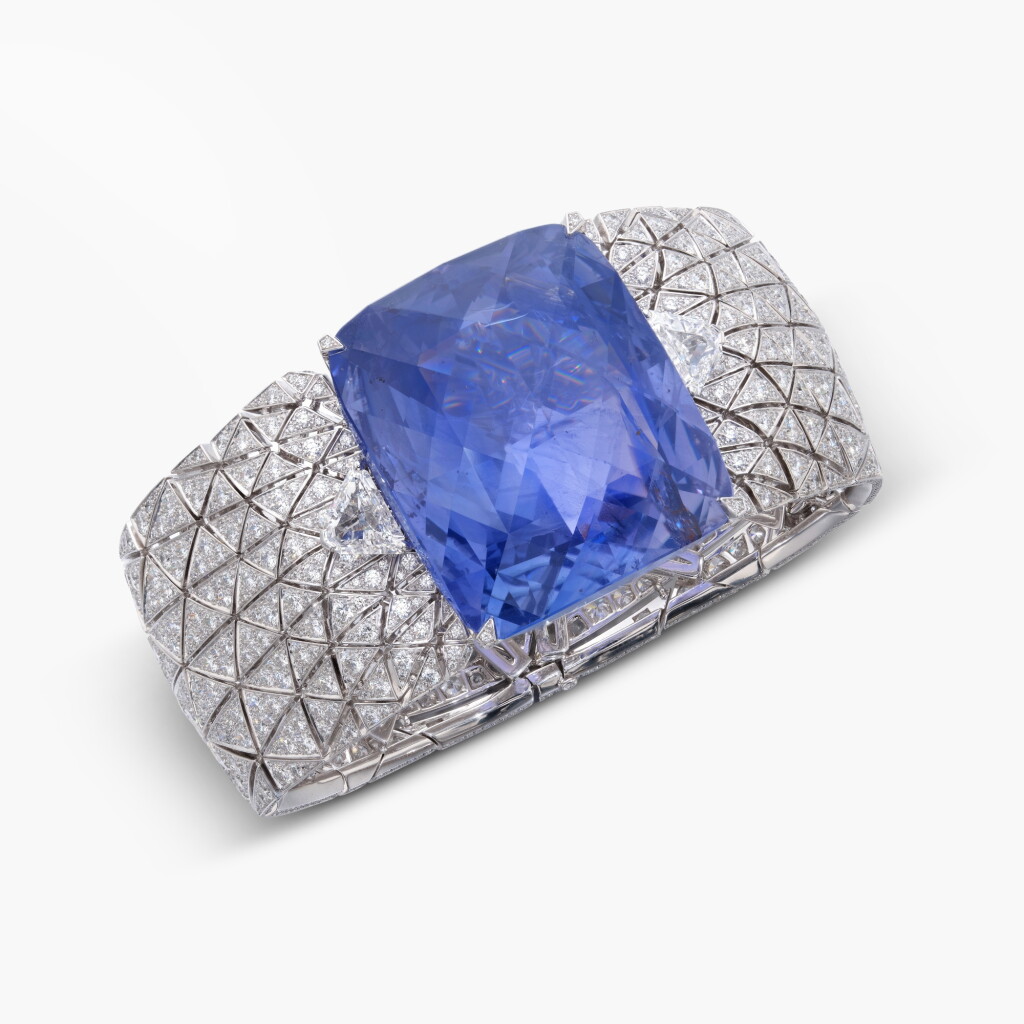
That distinction, between the stone and whatever holds it, is how work at a bench is organised. A setting is made around a stone; it can be unmade or replaced without changing the stone itself. The mountings here have names, dates and styles. The sapphire has a weight, an origin and a cutting style, and those stayed where they were while everything around it changed.
The paper that follows the stone describes the stone, not the bracelet. Reports from SSEF and Gübelin accompanying the lot state the weight as 197.80 carats, the origin as Ceylon, and record no indications of heating, with appendix letters from both laboratories. The most recent reports, dated December 2025 and January 2026, repeat findings made a decade earlier. Settings come and go; the document identifies what remains.
The earliest setting on record was not a bracelet. In the Fersman catalogue of the Russian Crown Jewels, the stone appears as a brooch, set in a cluster with a diamond border. The catalogue gives the date of the photograph as 1924–1926. It does not give a setting date. The earliest documented setting of the stone in a bracelet is the Cartier bracelet it was sold in, in 2015. The lot history records that Cartier bought the sapphire in 2012.
After the Revolution, the Soviet authorities divided the Crown Jewels for keeping or for sale, and records place this stone in a group sent abroad. Soviet sources list it among goods consigned in 1927. It was then offered by Christie’s, London, as lot 10 on 28 November 1927, for £6,000 to £8,000 (about C$11,000 to C$15,000). The buyer at that sale was recorded as a man in the room, who gave the name of a company, M. Zolotnitsky.
The next owner treated it the same way, as a centre to be remounted. Ganna Walska bought it from Cartier in 1927, after the Christie’s sale, and Cartier remounted it for her as a necklace in 1932. A later Cartier bracelet, in the Mughal-era style, was the setting in which it was photographed in 1957. The sapphire itself did not change in these settings.
Its present setting makes the arrangement explicit. In 2015, Cartier built a geometric diamond bracelet for the sapphire, with a detachable clasp, designed so that the stone could be removed and worn as a pendant. At Sotheby’s Geneva, it will be offered in that bracelet, as the centre of the lot.
— Tom