On November 2, 2026, GIA announced that it has acquired a collection of 2,665 crystals, gems and minerals, each one kept for what is inside it. Every piece exhibits inclusions: foreign minerals enclosed in the host crystal, fluids trapped as it grew, or structural features left by its growth. The collection was curated over 60 years by John Koivula, an analytical microscopist at GIA. Selected pieces will debut at the AGTA Tucson GemFair and the Tucson Gem and Mineral Show in February 2027.
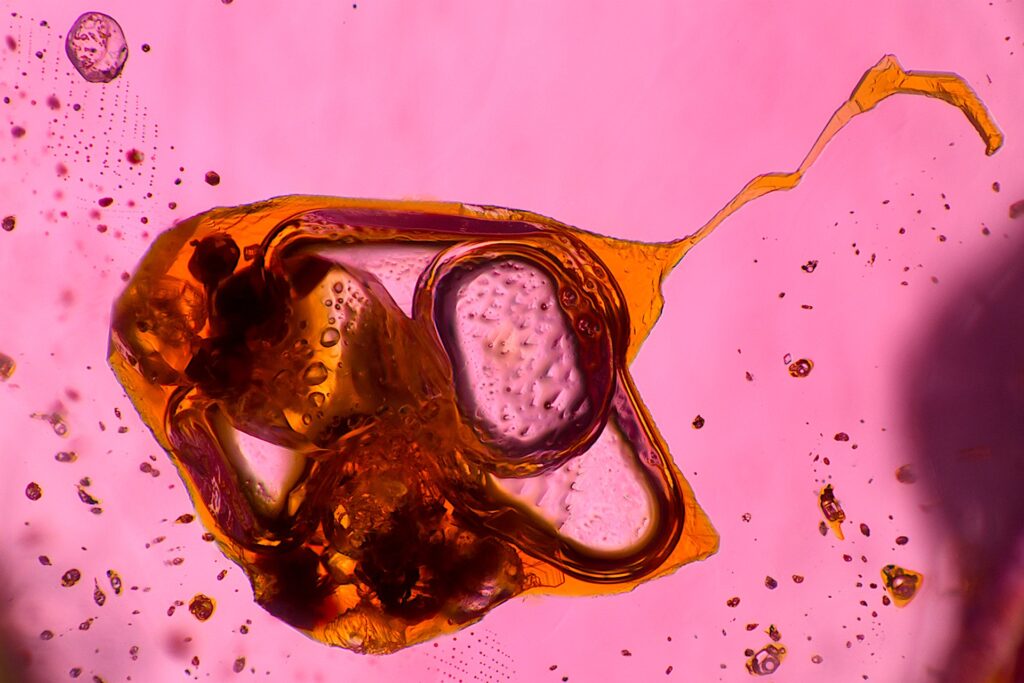
An inclusion is usually treated, in ordinary talk about gems, as a fault: something that lowers clarity and, with it, value. In the laboratory the same feature is read the other way round, as evidence. A crystal traps other material as it grows, and what it traps depends on where and how it grew. Gemmologists use those trapped materials to help determine whether a stone is natural or laboratory-grown, because natural and synthetic stones can carry different, characteristic inclusions, and in some cases inclusions give clues to where a stone was formed. Read that way, the inside of a stone is a record, and a collection of inclusions is a collection of records kept for comparison.
That is the work Koivula has spent his career on. He is among the most senior researchers at GIA, having joined the Institute in 1976, and he had been collecting specimens with inclusions since childhood. Through photomicrography — photographing the interior of gems through the microscope — he introduced techniques including fibre-optic illumination, now commonplace in gem laboratories worldwide. With Edward J. Gübelin he co-authored the three-volume Photoatlas of Inclusions in Gemstones, built on the same principle as the collection: an inclusion can only be identified reliably if a documented example exists to compare it with.
The examples were chosen slowly. They include a fan of tourmaline in mica and fluorescent petroleum fluid trapped in quartz. Terri Ottaway, curator of the GIA Museum in Carlsbad, said the assemblage could not be reproduced today, because many pieces are unique and specimens of comparable quality are unlikely ever to be found again. She also described the selection: Koivula would often examine hundreds of specimens before selecting a single piece. So 2,665 is not a count of stones gathered. It is a count of stones that passed that examination, out of a far larger number that did not.
What happens to the collection now is practical. It has been catalogued in a custom database, and GIA says it will support its education programmes, its gemmological research, and its gem identification and origin services, and expand its reference collection for training future gemmologists. Koivula and his colleagues are also preparing a large-format book of photomicrographs of the specimens.
For anyone who works with stones, the point of the acquisition is the comparison it preserves. An unfamiliar inclusion under the microscope is answered, when it can be answered, by matching it against a known example whose identity is already established. A reference collection is what makes that matching possible, and its usefulness depends on the quality and documentation of its pieces. Sixty years of selecting, at the rate of hundreds examined for one kept, have now passed into the keeping of the institute where Koivula has worked since 1976 — so the records stay available to those who will need to read them.
— Tom