Two sponsored honours inside the 2026 AGTA Spectrum & Cutting Edge Awards asked entrants to work to a brief narrower than the main categories. Platinum Honors judged one metal. The new Stuller Color of the Year Award judged one colour. The winners show what happens when the material, or the hue, is fixed before the design begins.
The American Gem Trade Association announced the winners of its 2026 competition after judging at the Omni Frisco Hotel at the Star in Dallas. Entries rose 21 percent over the previous year, to approximately 400. The Spectrum division judges finished jewellery; Cutting Edge judges loose stones and lapidary work. Inside those divisions, sponsors Platinum Guild International and Stuller ran their own awards.
Platinum as Structure
Platinum Honors covered more than 60 platinum entries in coloured gemstone and natural or cultured pearl jewellery, across categories from Evening Wear to Engagement Rings. Jenny Luker, president of Platinum Guild International USA, judged the category alone. One winner was named in each of the seven Spectrum categories, with two further distinctions on top.
Best Use of Platinum and Color went to Roland Krainz of Krainz Creations for “Ambrosia,” a platinum necklace set with opals and accented by diamonds, emeralds, sapphires and tsavorite garnets, 140.80 carats in total. Best Use of Platinum Crown went to Ricardo Basta of E. Eichberg, Inc. for “Everest,” a platinum ring with a 9.70-carat cushion-cut tanzanite and diamonds.
The seven category honours went to Jeffrey Bilgore for a moonstone and natural conch pearl necklace in Bridal Wear, Gabriel Angulo for a stretchable platinum ring with titanium springs and a black opal in Business/Day Wear, Eve Streicker for the “Zellige” aquamarine brooch in Classical, the Underwood design team for a cushion sapphire ring in Engagement Rings, Joseph Dardashti for the “Horus Egyptian Revival” bracelet in Evening Wear, Cari Goldman for the “Love Spun” crystal opal ring in Innovative Design, and Ricardo Basta again, for the “Siren’s Relic” zoisite ring in Men’s Wear.
Read from the bench, that list is a study in what platinum is asked to do. Luker pointed to its durability, strength and tensile properties: intricate micro-pavé and delicate prongs that still hold a stone securely. In these pieces the metal is rarely the subject. It is the structure that lets a soft opal, a large tanzanite or a spread of small coloured stones sit where the design needs them, and stay there.
One Colour: Signature Red
The Stuller award worked the other way round: the stones were the brief. Stuller, the Louisiana manufacturer and supplier, had named “Signature Red” its colour of the year for 2026. The new award, judged by Lauren Stuller and Charles Evans, honoured exceptional interpretations of that red in both divisions, and drew more than 50 submissions.
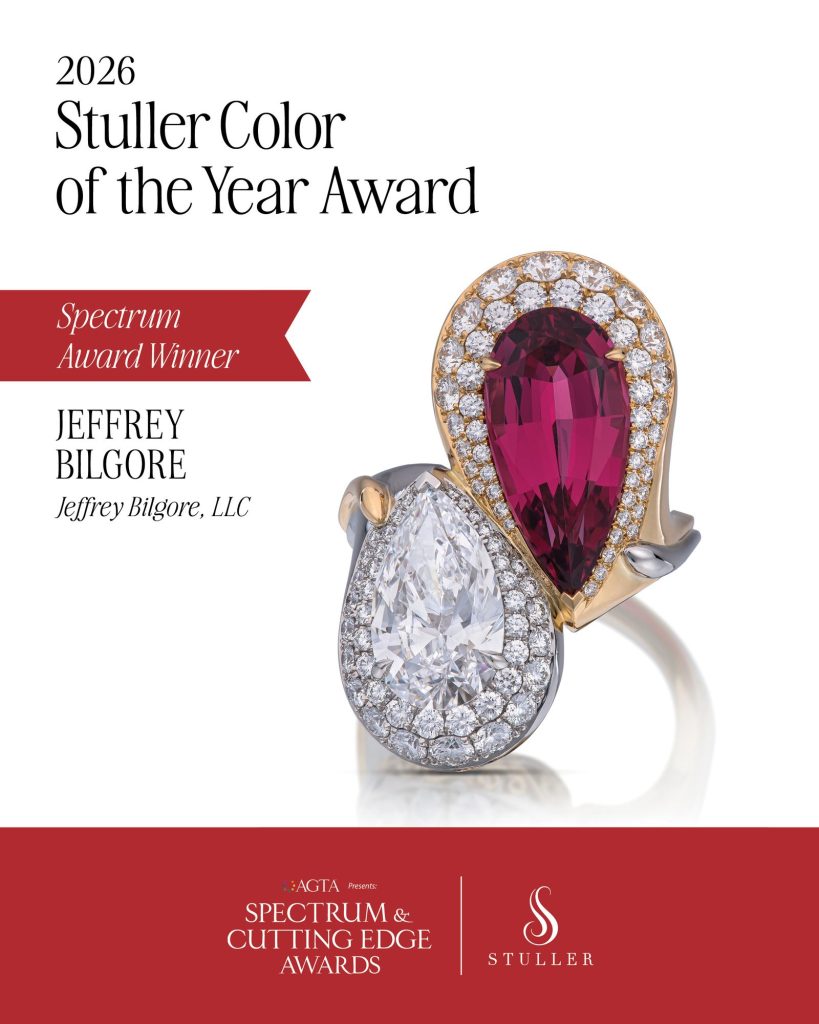
In Spectrum, the award went to Jeffrey Bilgore for “Neuvelle Moi et Toi Forever,” an 18-karat yellow gold and platinum ring set with a 6.21-carat unheated red Mahenge spinel and a 3.06-carat diamond, accented by diamonds. The same ring took second place in the Classical category. In Cutting Edge, it went to Alan Afshin Hackman of Intercolor USA, with David Hackman, for a 7.33-carat oval ruby from Madagascar. Cindy Zhang was named Spectrum runner-up for “Bleeding Heart, Not Broken,” a brooch centred on an 8.63-carat heart-cut rubellite tourmaline.
Three reds, three different materials: a spinel, a ruby and a rubellite tourmaline. That is the point the award makes without stating it. A colour in jewellery is never just a colour. Each red stone brings its own hardness, its own way of taking light, and its own limits at the bench, and the setting has to be built around the stone that carries the hue, not around the hue itself.
Many of the winning pieces will be on display at AGTA GemFair Tucson, from January 31 to February 4, 2027, at the Tucson Convention Center, with the awards gala on February 3.
— Tom