A stone can look like one thing and be built like another. That is the whole subject of doublets and triplets. They are not a kind of mineral. They are a kind of construction: two or three pieces joined together and cut, set, and sold as a single stone. Once the construction is understood, most of the confusion around them falls away. The question is never simply whether the stone is beautiful. It is how many layers it has, what each layer is, and whether the seller has said so.
Two layers, three layers
The words are literal. A doublet is an assembled stone made of two separate pieces of material fused or cemented together. A triplet is made of three separate pieces, or of two pieces with a coloured cement layer between them. Gemmology counts them as assembled stones, a recognised category of their own, distinct from a single natural stone, a synthetic stone, and an imitation.
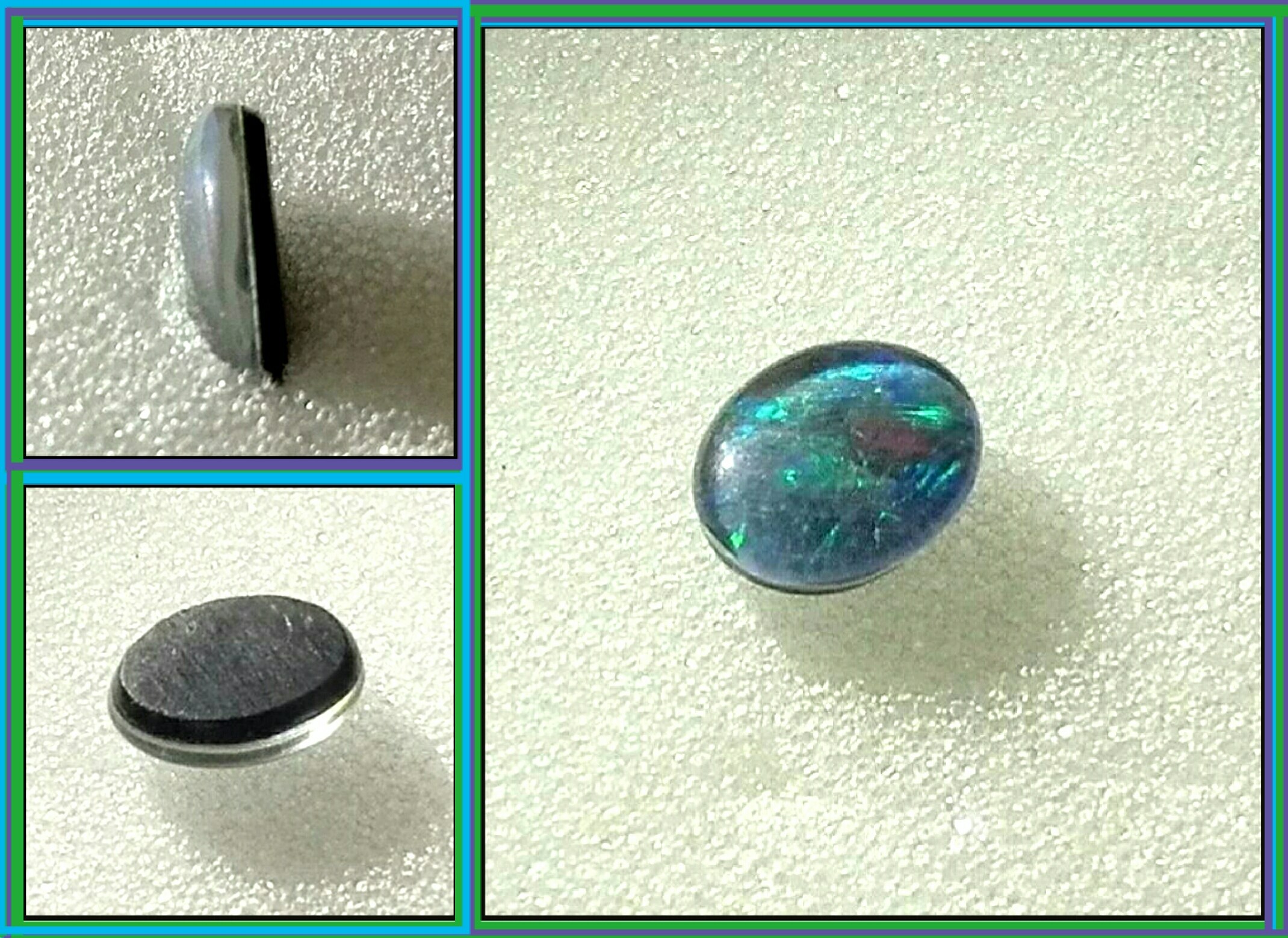
The classic examples show why the construction exists. An opal doublet is usually a thin slice of precious opal, the layer that carries the play of colour, cemented to a backing. The backing may be common opal without play of colour, known as potch, or ironstone, basalt, or another dark material. The backing gives a thin, fragile slice something to sit on, and a dark ground against which its colour reads more strongly. An opal triplet adds a third layer on top: a clear cap, commonly quartz or glass, cut as a cabochon. The cap protects a very thin opal layer and, because it is domed, it can also magnify it.
Other doublets work the same way. In the long-standing garnet-and-glass doublet, a thin crown of garnet sits over a pavilion of glass: the garnet gives the face its lustre and hardness, the glass below supplies bulk and colour. Sapphire and synthetic corundum doublets and beryl triplets follow the same pattern.
Why a layered stone is made at all
Layering is not, by itself, a trick. Some precious material occurs in seams too thin to cut and set on its own. Without a backing, it would break in the setting or in wear, or it would never be used at all. A doublet turns that thin slice into a stone that can be worn. The same is true, more sharply, for a triplet: the opal layer inside some triplets is a wafer, a fraction of a millimetre thick, and only the cap and the backing together make it into a piece of jewellery.
There is also a question of appearance. A dark backing behind a pale or translucent stone changes how its colour is read. It is the same principle as a dark cloth behind a pale object: the colour looks deeper because the ground behind it is darker. That is not a defect in the stone. It is a decision made at the cutting bench, and like any decision in jewellery, it should be visible to the buyer in the description, if not in the stone itself.
The difficulty begins when the construction is hidden. A doublet sold or priced as a solid stone is a different object from a doublet sold as a doublet, even if the two look alike in a photograph: the amount of precious material is different, and glue and glass do not behave like a single crystal. Disclosure is what separates an honest assembled stone from a misdescribed one.
How to see the join
Most doublets and triplets can be suspected without any instrument, provided the stone can be seen from the side. A solid opal shows one material running through, even when its colour is uneven. A doublet, seen edge-on, shows a line: colour on top, backing below. A triplet shows two lines: clear cap on top, a thin coloured layer in the middle, backing below. The line in an assembled stone is usually straight and clean, because it is where two cut surfaces were joined. That straightness is itself a clue.
Under a loupe, the join usually gives itself away further: flattened bubbles trapped in the cement, a thin dark adhesive layer, or a flat plane where the two halves meet. In a garnet-and-glass doublet, the lustre of the garnet crown and that of the glass pavilion do not match. In immersion, where a loose stone is held in water and viewed parallel to its girdle, the two halves of a doublet separate visually, and a triplet shows a strong band of colour between nearly colourless portions. These are bench observations, not tests to try at home on a set stone.
There is one caution. A natural opal can also show a line between its colour bar and the common opal beneath it, but in a natural stone that boundary is usually irregular, with the two materials bleeding into each other. A straight line is a reason to ask questions, not a verdict on its own, and a set stone, where the girdle and back are hidden by metal, is harder to judge than a loose one. If the construction cannot be seen, the written description has to carry the weight.
What layering changes in wear
An assembled stone asks for different care from a solid one. The cement between the layers is the weak point: heat from a jeweller’s torch during resizing or repair can damage it, as can prolonged soaking, harsh chemicals, and ultrasonic cleaning. A triplet cap of glass or plastic scratches more readily than the stone it protects. A doublet or triplet described honestly can still be worn for years; it simply should not be treated as one solid crystal.
That is why the repair bench needs to be told. Before a ring with a layered stone is resized, retipped, or cleaned, the jeweller should know that the stone is assembled: a repair routine on a solid stone can be the wrong repair on a doublet. The information is part of the piece, and it should travel with it from seller to owner to repairer.
The test, in the end, is a short one. Ask how many layers the stone has, what each layer is made of, and whether that construction is stated on the receipt or the laboratory report. A seller who can answer those three questions without hesitation is selling an assembled stone. A seller who cannot, or who calls the stone solid when it is layered, is selling something else: the same appearance, without the same facts.
— Tom