Paste is a word that now sounds like an apology. In jewellery, it means glass cut and set to look like a gemstone, and it is usually taken to mean a cheap substitute, a stone for someone who could not afford the real thing. The history does not support that reading. For much of the eighteenth century, paste was worn openly, at court, by people who owned diamonds as well. It was not a failed diamond. It was a material with its own makers, its own technique, and its own place in fashion, and it is collected today for exactly those reasons.
What paste is
Paste is lead glass. The lead is the point. Ordinary glass is too soft and too dull to be faceted like a gemstone; lead glass is softer to cut, takes a polish, and has a higher refractive index, which means it bends light more strongly and throws back more sparkle. Coloured with metallic oxides, it can be made in almost any gem colour. Left colourless, it can stand in for diamond, at least by candlelight.
Glass had been used to imitate gems since antiquity, and the Romans were already doing it well enough for Pliny the Elder to complain about the profit in counterfeiting genuine gems with glass pastes. What changed in the later seventeenth century was the glass itself: the English glassmaker George Ravenscroft developed a lead crystal glass that could be faceted and polished rather than merely moulded, and that made a cut glass stone possible.
The man whose name stuck to the material was the Parisian jeweller Georges Frédéric Strass. Working in Paris in the 1720s, he refined the lead glass, had it cut and polished with metal powder for a higher brilliance, and set it with the same care given to diamonds. His shop on the Quai des Orfèvres became the most famous paste jeweller’s in Paris, and in 1734 he was appointed Jeweller to the King of France. In France, paste jewellery became known as strass, after him. The appointment matters because it answers the usual assumption about paste: a king’s jeweller was not making it in secret for people who could not tell the difference.
How paste was worn
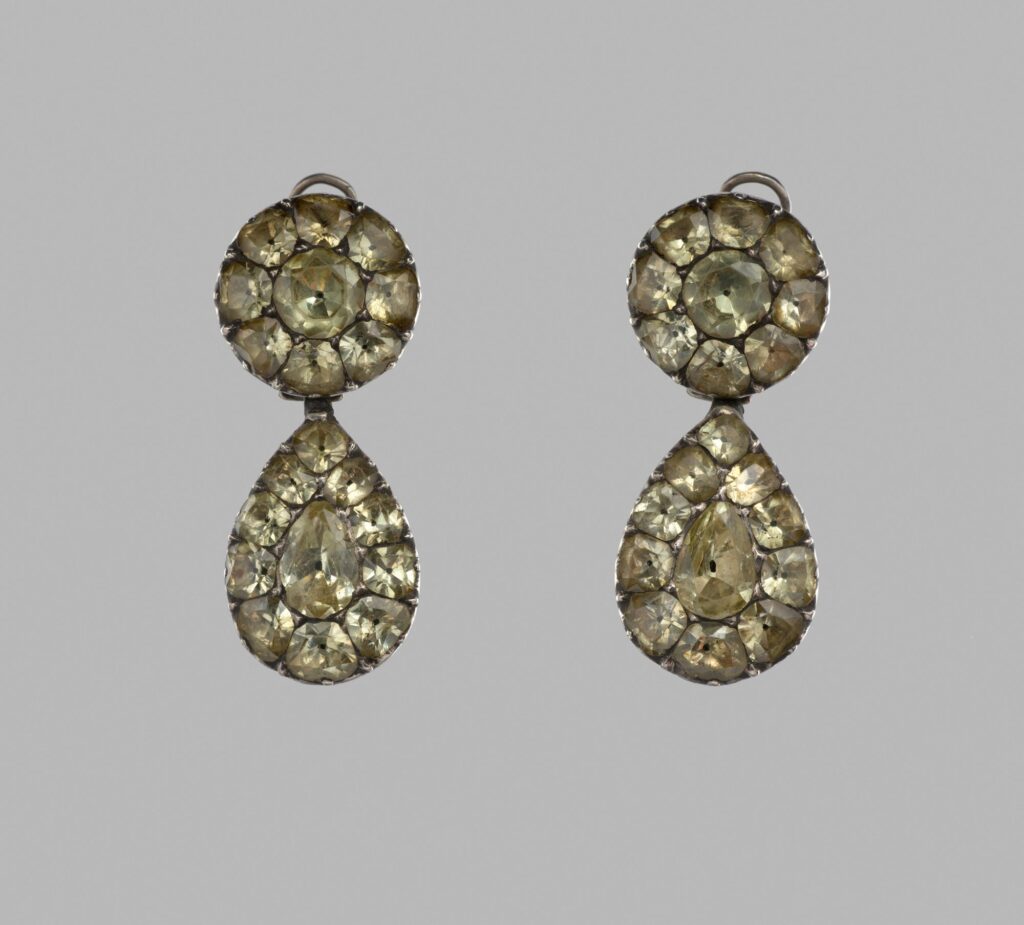
Paste stones were usually set in closed-back mounts, often foil-backed. A thin sheet of metal foil behind the stone, sometimes coloured, deepened its colour and threw light back through it. The setting was part of the optics, not an afterthought. Georgian paste also carries a small, telling detail: a black dot painted on the culet, the pointed bottom of the stone, which deepened the shadow at the centre and made the stone read, in candlelight, with the depth of a diamond. The term for it, black dot paste, survives among collectors.
Candlelight is not a decorative detail in this story. It was the light these jewels were made for. In a ballroom lit by candles, a faceted lead-glass stone, foil-backed and set in silver, threw back a convincing brilliance, and the difference between paste and diamond narrowed to a point where even experienced eyes hesitated. That is the sense in which paste fooled courts: not that courtiers were cheated in dark corners, but that in the rooms where fashion was judged, paste held its own beside diamonds, worn by women who had both.
It was also worn for reasons that had nothing to do with deception. Paste allowed a design to be made at a scale, and in colours, that cut diamonds of the period did not allow. Diamonds then had to be cut around the shapes in which the gems were found; paste could be cut to the design. A large, matched parure in a single colour, a girandole earring in blue, a suite of stones in a graduated necklace: these were easier in glass than in precious stone. Paste also let fashion move faster than the gem trade. A new silhouette could be tried in paste in a season, without committing the price of diamonds to it.
The wearers crossed the usual line between real and imitation. Marie Antoinette is reported to have worn paste ornaments as a change from diamonds, and Madame du Barry owned girandole earrings in blue paste. The middle classes, meanwhile, used paste to take part in the same fashions at a price they could pay. The same material served both ends because it was not pretending to be a social class. It was a fashion material, used knowingly, in the open.
Why collectors want it now
Antique paste is collected today as eighteenth- and early nineteenth-century jewellery in its own right, not as a curiosity about fakes. The reasons are the same ones that made it fashionable in its own time: the cutting, the setting, and the design. A good Georgian paste piece is set in silver with the care given to a diamond piece, and its value lies in that work and in its survival, not in the price of its stones. Museums catalogue paste pieces alongside precious ones, with the material stated plainly, because the piece is the object, not the stone inside it.
That changes how paste should be judged in an old piece. The question is not whether the stone is a diamond: it is not, and the closed back, the foil, and sometimes the black dot say so. The questions are whether the cutting is fine, whether the setting is original and well made, and whether the design belongs to its period. A paste stone reset in an open mount, or refoiled carelessly, has lost part of what made it work.
There is also a distinction worth keeping. Later machine-cut glass, including the industrial rhinestones of the twentieth century, descends from the same idea but is not the same craft. Georgian paste was hand-faceted, hand-polished, and set by jewellers working to the fashions of their own rooms. The difference is visible in the cutting: hand work leaves small irregularities that machine cutting does not, and a closed, foil-backed setting is a period construction, not a modern one.
Paste, then, is best understood as a material that was honest about being glass and ambitious about being jewellery. It did not need to be a diamond to be worn at court. It needed to be well cut, well set, and in fashion, and for a century it was all three. The stones in an old paste necklace are still glass. The necklace is still worth looking at closely, for the work in it rather than for the stone it imitates.
— Tom