A modern round brilliant is cut to a formula, measured in percentages and angles, and it sparkles in fine, bright flashes. An old cut is cut by eye, with hand-powered tools, to no formula at all, and it glows in broader, softer flashes. The difference is visible before any name is attached to it. Two old cuts account for most of what is found in antique jewellery: the mine cut and the rose cut. They are not two versions of the same idea. They are two different answers to the problem of making a rough diamond shine, from two different centuries, and they are recognised by different features.
The rose cut: a dome with no pavilion
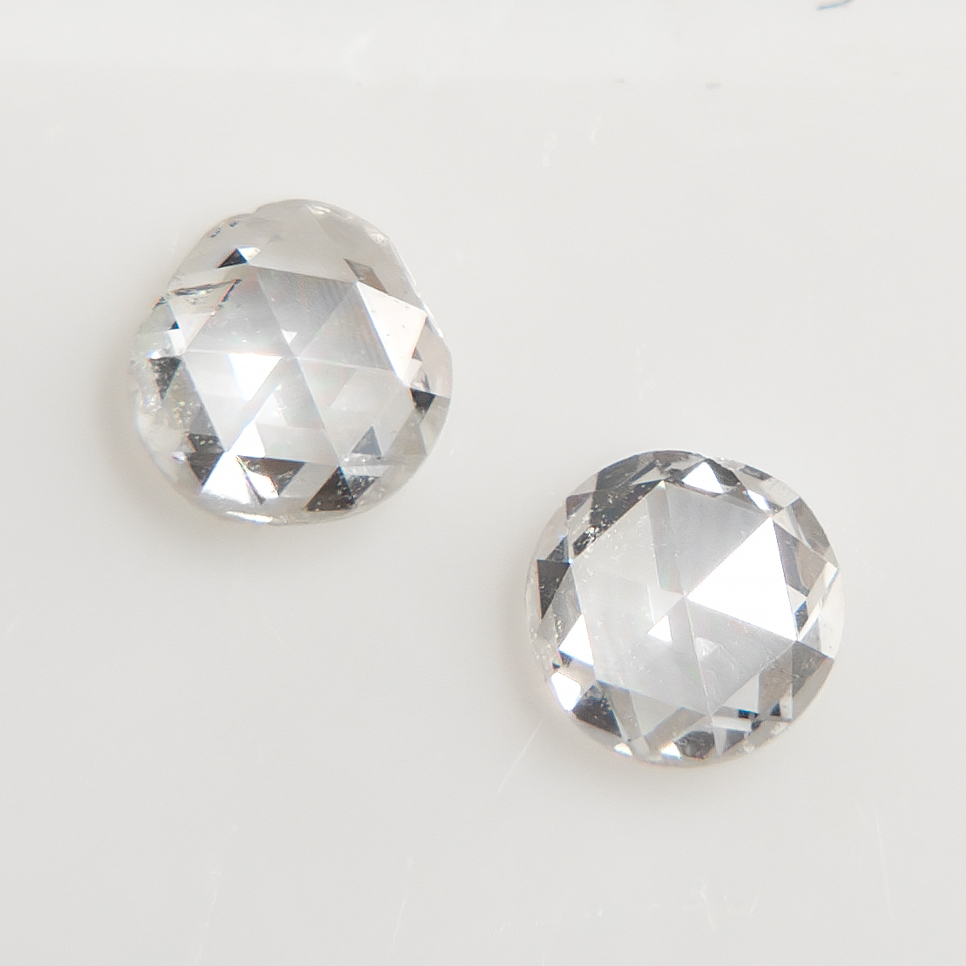
The rose cut is the older of the two. It appears in Europe in the 1500s, and it remains in use through the Georgian and Victorian periods. Its construction is simple to describe and unlike any modern cut. The bottom is flat. There is no pavilion, the lower portion of a modern stone that returns light upward, and there is no table, the large flat facet on top of a modern stone. Above the flat base rises a dome, covered in triangular facets arranged in a pattern that suggests the petals of a rosebud, from which the cut takes its name. The number of facets varies, commonly between twelve and twenty-four, depending on the size of the stone and the hand that cut it.
Recognising a rose cut is usually straightforward. Look for a flat back, a domed top of triangular facets meeting at a point or a small flat apex, and no table facet. The outline can be round, oval, square or pear-shaped, because the dome follows the shape of the rough rather than forcing it into a circle. The facets are large and few, not the many small facets of a brilliant, and the symmetry is approximate: one side of the dome may not quite mirror the other, because the stone was cut by eye and finished by hand.
The mine cut: the cushion ancestor of the brilliant
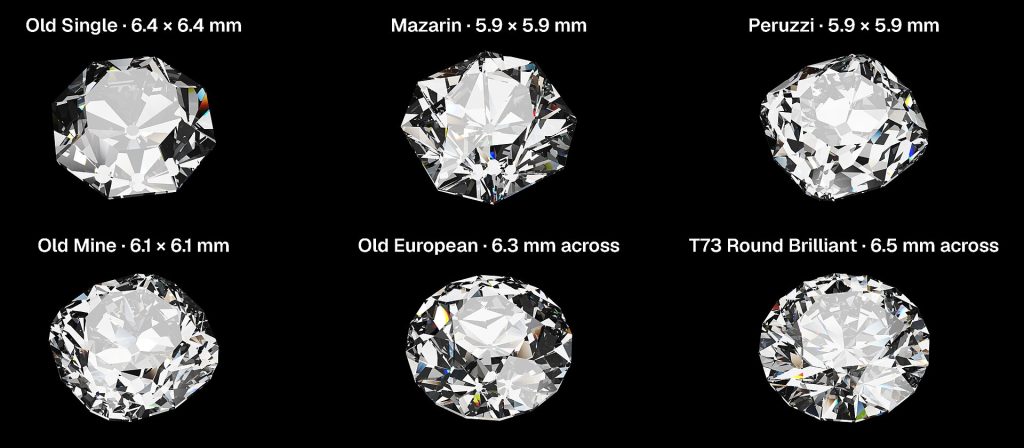
The mine cut, usually called the old mine cut, appears in the late 1600s and becomes the standard diamond cut of the 1700s and 1800s, the classic stone of Georgian and Victorian jewellery. Its name is a later one: it was applied to stones that came from the older mines, of India and Brazil, before the South African mines changed the trade, and it stuck as the name of the cut itself. The mine cut is a cushion-shaped stone, square or rounded-square in outline with softly rounded corners, and it is the direct ancestor of the modern cushion cut and, through the old European cut that followed it, of the modern round brilliant.
Its proportions are the opposite of a modern brilliant’s in almost every respect. The crown, the upper portion of the stone, is high. The table is small, a fraction of the diameter that a modern table occupies. The pavilion is deep, and the facets are large, cut by hand to no measured angles. At the bottom of the pavilion, where a modern brilliant comes to a point, the mine cut has an open culet: a flat facet, large enough to see with the naked eye as a small circle or octagon when the stone is viewed face up. That culet is the single most reliable mark of the cut. A modern brilliant has a pointed or very small culet, invisible face up. A mine cut’s culet looks back at the viewer.
The light of a mine cut follows from those proportions. The high crown and deep pavilion, with large facets, produce broad flashes of white light and colour, chunkier and warmer than the fine scintillation of a modern brilliant. The open culet leaks a little light at the centre, which is why a mine cut can show a dark or empty spot in the middle under some lighting, and why its pattern of light and dark is more open and less even than a modern stone’s. Cut by eye, no two mine cuts are identical. One may be slightly off-round, another slightly tilted, a third with facets that do not quite meet. That irregularity is not damage. It is the evidence of hand cutting, and it is part of how a mine cut is distinguished from a modern cushion cut made to imitate it.
Reading the two cuts together
The rose cut and the mine cut are sometimes found in the same period of jewellery, and they are sometimes confused, but they are not hard to separate once the construction is understood. The rose cut has no pavilion at all, and its back is flat. The mine cut has a deep pavilion, and its back comes to a broad, flat culet. The rose cut’s top is a dome of triangles. The mine cut’s top is a crown with a small table and large surrounding facets. The rose cut is shallow and light for its spread. The mine cut is deep and heavy for its spread, because so much of its weight sits in the high crown and deep pavilion.
What the cut can and cannot date
A cut is a strong clue to the age of a piece, and it is not proof of it. Stones were replaced, reset and recut over the centuries, and a Victorian ring can carry a later stone, just as a modern ring can carry an old stone salvaged from a damaged piece. The cut should agree with the rest of the piece: the metal, the hallmarks, the style of setting, and the construction. A rose cut in a closed-back silver setting with Georgian hallmarks tells a consistent story. A rose cut in a modern claw setting with a laser inscription tells a different one, and the later setting, not the cut, is likely the true date of the piece as it now stands.
— Tom