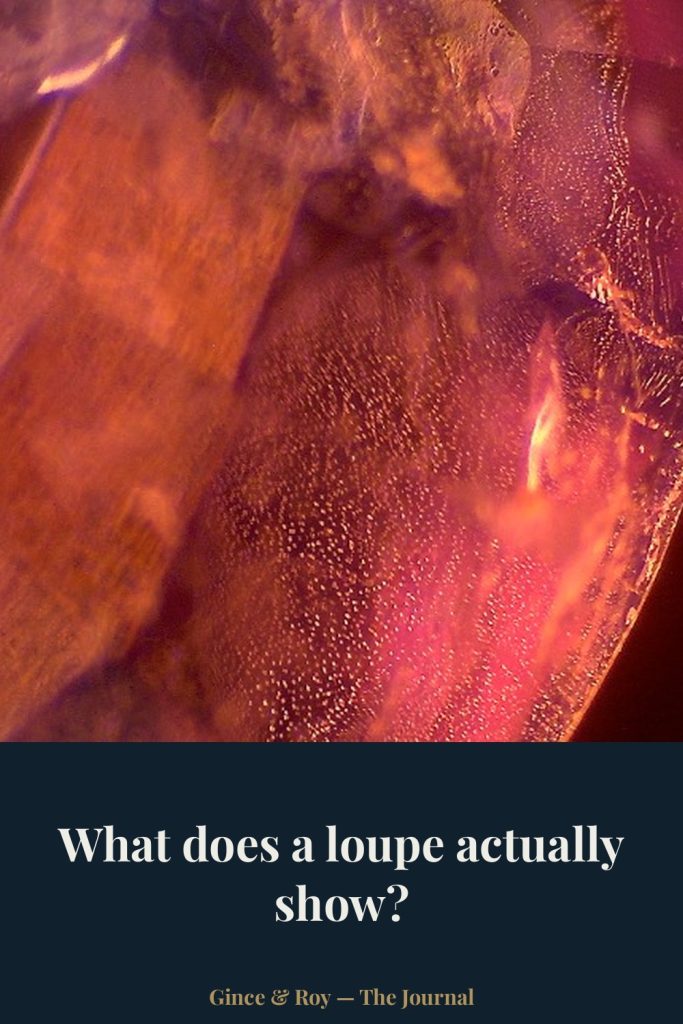
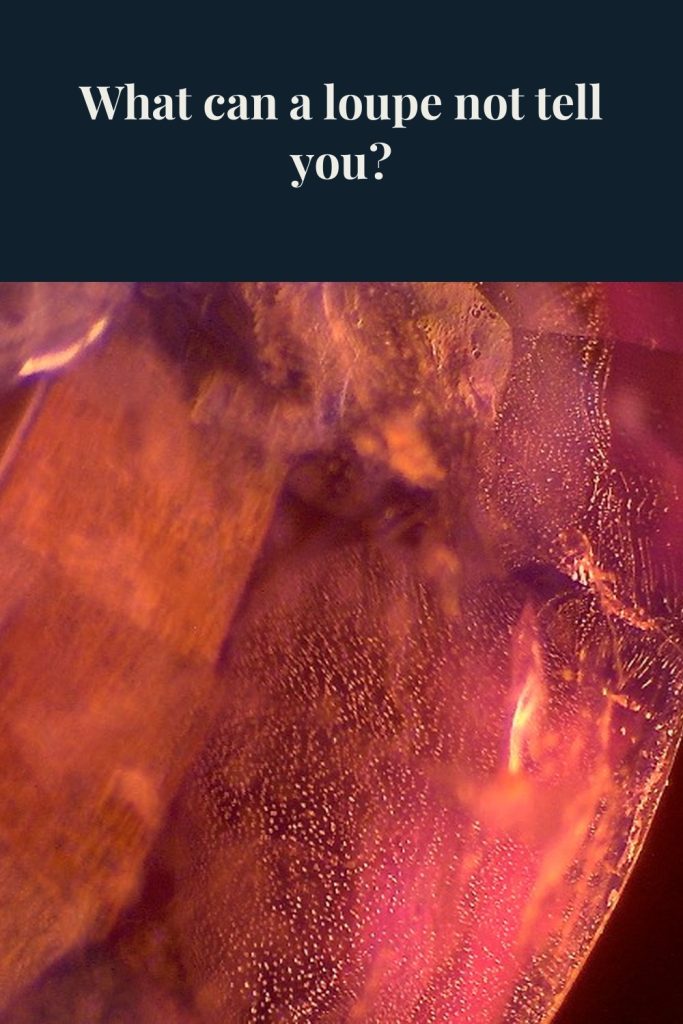
A loupe is a small magnifier, and the standard one in gemmology magnifies ten times. It is a triplet, three lenses cemented together to correct the distortion a single lens would introduce, and it is held close to the eye while the stone is brought up to it. Everything a gemmologist first learns about a stone is learned at that magnification, or not learned at all. The loupe does not identify a stone on its own. What it shows, carefully read, is the interior life of the crystal, and that interior is as individual as a fingerprint.
What counts as an inclusion
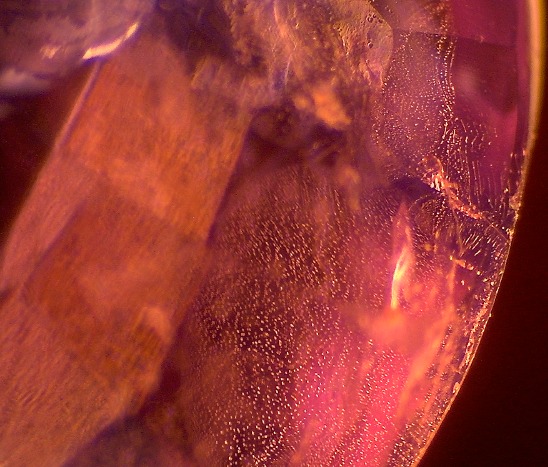
An inclusion is anything inside a stone that is not the host crystal itself: a tiny crystal of another mineral, a needle, a fracture, a cavity filled with fluid, a cloud of minute particles, a growth zone where the crystal changed direction as it formed. Gemmologists use the word broadly. A feather is a small fracture, often with a feathery outline. Silk is a crowd of fine rutile needles, common in sapphire and ruby, that scatters light and softens the stone’s appearance. A cloud is a hazy region of tiny inclusions too small to resolve individually. A fingerprint inclusion, the feature that gives this article its title, is a partially healed fracture: fluid and tiny crystals trapped in a branching, fingerprint-like pattern where a crack in the growing crystal sealed itself over.
These features are not dirt in the stone, and they are not, in themselves, damage. They are the record of how the crystal grew, in what company, and under what interruptions. A crystal that grew undisturbed in a clean environment has few inclusions. A crystal that grew in a crowded pocket of rock, with other minerals forming alongside it, carries their traces. A crystal that cracked and healed carries the healed crack. The inclusion scene, the whole pattern of features together, is the record, and a single inclusion read alone is rarely decisive. The scene is what a gemmologist reads.
How the loupe is used
The examination starts at ten times magnification, and it starts with the table, the large flat facet on top, looking down into the stone. Then the stone is rocked slowly, so that light moves across the interior and features at different depths come into focus in turn. Darkfield illumination, in which light enters from the side and the background stays dark, makes inclusions stand out as bright features against darkness, and it is the lighting a darkfield loupe provides. Brightfield, with light coming from behind, is better for low-relief features such as curved growth lines. Diffused light shows colour zoning, the bands of stronger and weaker colour laid down as the crystal grew.
The habit that matters is to look at the whole stone, not to hunt for a single tell-tale mark. A gemmologist notes where each feature sits, its shape, its depth, and its relationship to the other features. A needle alone suggests little. Needles together with a particular zoning pattern, and with crystals of a certain shape, begin to suggest a species, a treatment history, or an origin. The GIA’s teaching on magnification makes the same point: the entire inclusion scene is the evidence, and individual features gain meaning from the company they keep.
What inclusions can tell
Inclusions can separate natural stones from laboratory-grown and imitation material, though never by a single feature. Natural stones typically show a greater variety of inclusions than laboratory-grown stones, because natural growth is irregular and crowded. Laboratory-grown stones often show the marks of their growth method: curved growth lines, called curved striae, in flame-fusion material, where the crystal was built drop by drop, or the small metallic inclusions left by a high-pressure growth chamber. Glass imitations show gas bubbles, round and scattered, which natural crystalline gems do not contain, except for natural glasses and resins themselves. A stone full of round bubbles is not a crystal at all, whatever its colour suggests.
Inclusions can also record treatment. Heat treatment alters inclusions: crystals inside a heated sapphire may show melted edges, tension halos, or a dissolved, snowball-like appearance, and rutile silk may partially dissolve. A scene of altered crystals together with tension halos is, taken together, strong evidence of heating, where any one feature alone would only suggest it. Fracture filling leaves its own traces, such as a flash effect, a flicker of colour seen as the stone is turned, where the filler meets the host crystal. Dye in a treated stone concentrates along fractures, visible as colour gathered in lines rather than spread evenly through the crystal.
The fingerprint, properly understood
The fingerprint metaphor is exact in one respect and misleading in another, and both halves matter. It is exact because no two stones carry the same inclusion scene. The positions, shapes and depths of inclusions in a particular stone are unique to that stone, and a laboratory can plot them, or photograph them, as a means of identifying that individual stone again later. A stone returned for re-examination, or claimed as stolen property, can be matched to its earlier inclusion plot in a way that weight and measurements alone could never achieve. In that sense, inclusions are an identity document written inside the stone.
What the loupe cannot do
The limits of the loupe are as important as its uses, because they are where confident claims go wrong. A loupe cannot separate a natural diamond from a laboratory-grown diamond. The two are the same material, and the growth differences between them are, in most cases, too fine for ten times magnification, requiring advanced laboratory instruments and spectroscopic analysis. A loupe cannot prove a stone’s origin, and it cannot detect every treatment. Some treatments, such as beryllium diffusion in sapphire, leave traces that require chemical analysis to confirm, because the diffusing element is present in amounts too small for ordinary gemmological instruments to detect.
Used within those limits, the loupe is the most honest instrument in gemmology, because it shows the stone rather than a number about the stone. It rewards patience and punishes haste: a quick glance finds the obvious feather and misses the scene. A slow examination, stone rocked, light shifted, features noted in relation to each other, reads the history the crystal carries. That history, written in inclusions, is the closest thing a stone has to a signature, and the loupe is how it is read.
— Tom