On 11 November in Geneva, Sotheby’s sold the Romanov sapphire for CHF 4,122,000 (about C$7 million). The result was the top price of the Royal & Noble Jewels sale, which took CHF 15.3 million in total, and it was more than twice the lot’s high estimate of CHF 1,700,000. The buyer was a private collector; Sotheby’s did not name them.
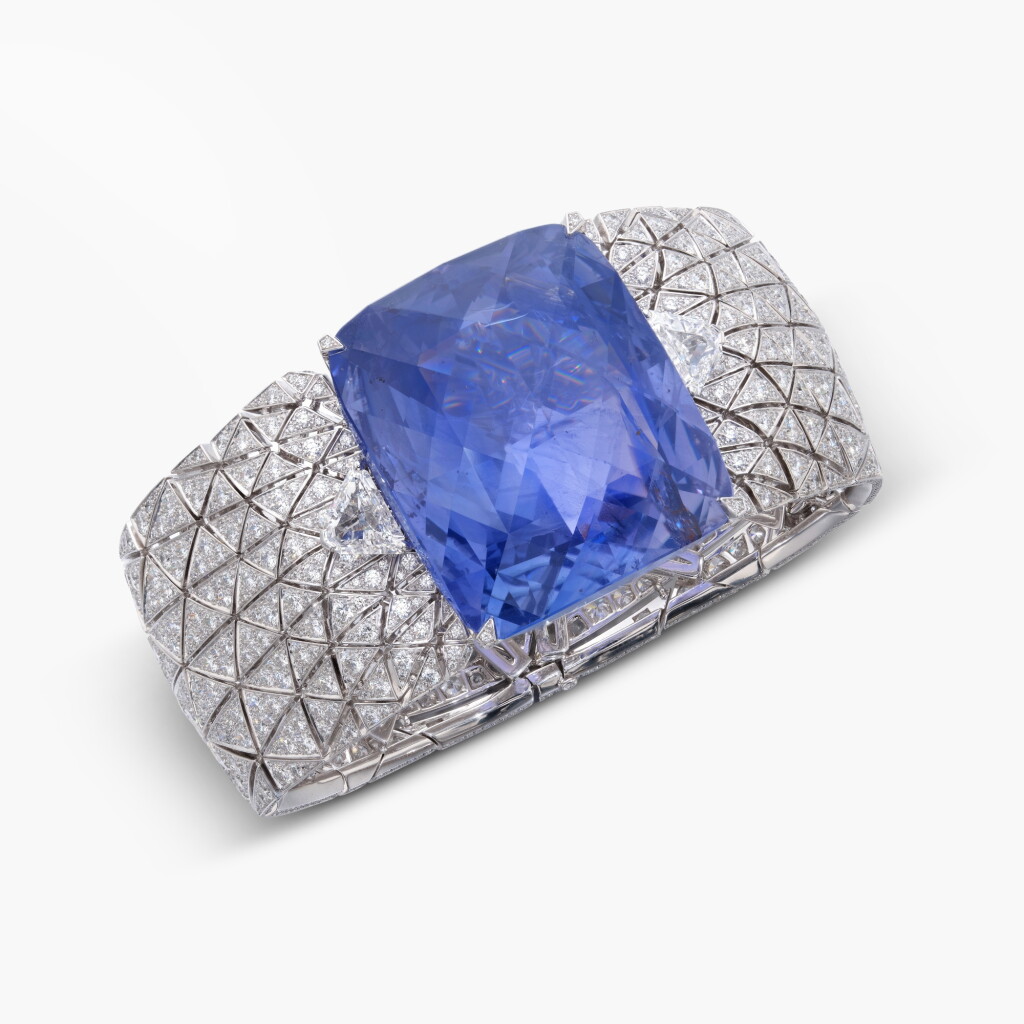
The Journal followed this stone before the sale, because of how its identity is carried. The lot was a Cartier bracelet, built in 2015, but the bracelet is the youngest part of it. At its centre sits a cushion-shaped sapphire of 197.80 carats, from Ceylon, now Sri Lanka, with reports from SSEF and Gübelin recording no indications of heating. The bracelet’s centre is interchangeable — an engraved rock crystal centre can be fitted in the sapphire’s place — so the object sold was, by design, a documented stone currently housed in a setting that lets it leave.
That is the order of things at a bench. A setting is made around a stone, and it can be unmade without changing the stone. What cannot be remade is the record: the Fersman catalogue of the Russian Crown Jewels, drawn up in 1924–1926, where the sapphire appears in a Fabergé diamond border, worn by the Dowager Empress Maria Feodorovna at the Winter Palace Ball of 1903; the Soviet dispersal sale that followed; the Cartier sautoirs of Ganna Walska, who bought the stone in 1927. The estimate was set against comparable stones. The room paid for the stone plus a chain of paper that no workshop can produce after the fact.
The same pattern, at a smaller scale, produced the sale’s other surprise. A Belle Époque brooch of about 1910, centred on a cushion-shaped padparadscha sapphire of 23.64 carats inside a millegrain-set diamond border, had been estimated at CHF 40,000 to CHF 60,000. It sold for CHF 1,120,000 — more than eighteen times the high estimate. The brooch came from the collection of Sibylla of Saxe-Coburg and Gotha, Duchess of Västerbotten, and passed to her daughter Princess Birgitta of Sweden, who received it from her mother on her marriage. Like the Romanov stone, the padparadscha is a Ceylon sapphire recorded as unheated, and like it, the brooch carried a royal provenance that could be traced, owner by owner, in documents.
Two lots do not make a market rule, and Geneva in November is not an ordinary room. But the two results point the same way. In each case the material alone — a large unheated sapphire, a rare pink-orange one — would have supported a strong price, and the estimates already reflected that. What the estimates did not hold was the documented history attached to the stones. A maker can cut a sapphire, and a laboratory can test it, but neither can manufacture a past. Where the past is written down and verifiable, it is priced as part of the object.
The Romanov sapphire now returns to a private collection, as it has after every sale since 1927. Its settings have never stayed with it for long. Its reports, its catalogue plate and its stated weight have — and on 11 November, those were worth more than the estimate allowed for the stone itself.
— Tom